Share this article



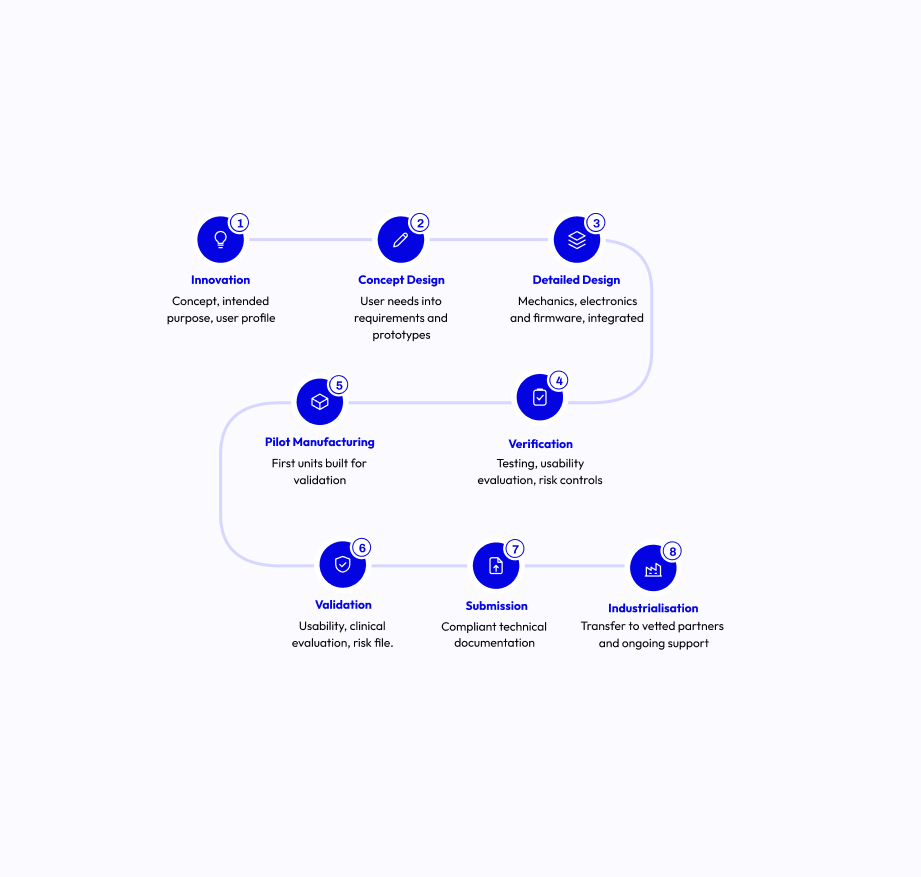
The medical device development process takes a device from a clinical need to a product that can be manufactured, certified and placed on the market. At Perdigó Medical, we run it in eight steps, from innovation to industrialisation, for devices headed to the EU, the US and the UK. This guide explains what each step involves, what it produces, and why this process is rarely linear.
The sections below cover each step in this order.
Innovation
Innovation, also called discovery stage, turns an early clinical need into a defined device concept. Its central task is to establish the intended purpose: what the device does, for which patients and users, and in which clinical environment. Under EU MDR, the intended purpose and the device’s inherent risks determine its classification, and the classification in turn sets the conformity assessment route and the clinical evidence the device will need.
Alongside the intended purpose, a feasibility assessment examines whether the concept is technically viable, which standards apply, which hazards and use-related risks can already be foreseen, and whether the patent landscape leaves freedom to operate. These questions are assessed together because their answers depend on one another: a change in the intended purpose can change the classification, a device designed without its clinical workflow in view may not fit that workflow, and an existing patent claim can force a different technical approach.
With these questions answered, the stage closes with the intended purpose, user profile and use environment documented, and with a design and development plan for the stages ahead, as ISO 13485 requires.
Concept design
Concept design turns the device vision into structured requirements, a system architecture and a proof-of-concept prototype.
Design inputs
User needs are captured with your clinical stakeholders and translated into structured, measurable technical requirements, which become the design inputs. From this point on, every design decision is made against them and every verification test is judged against them.
Concept generation and early prototypes
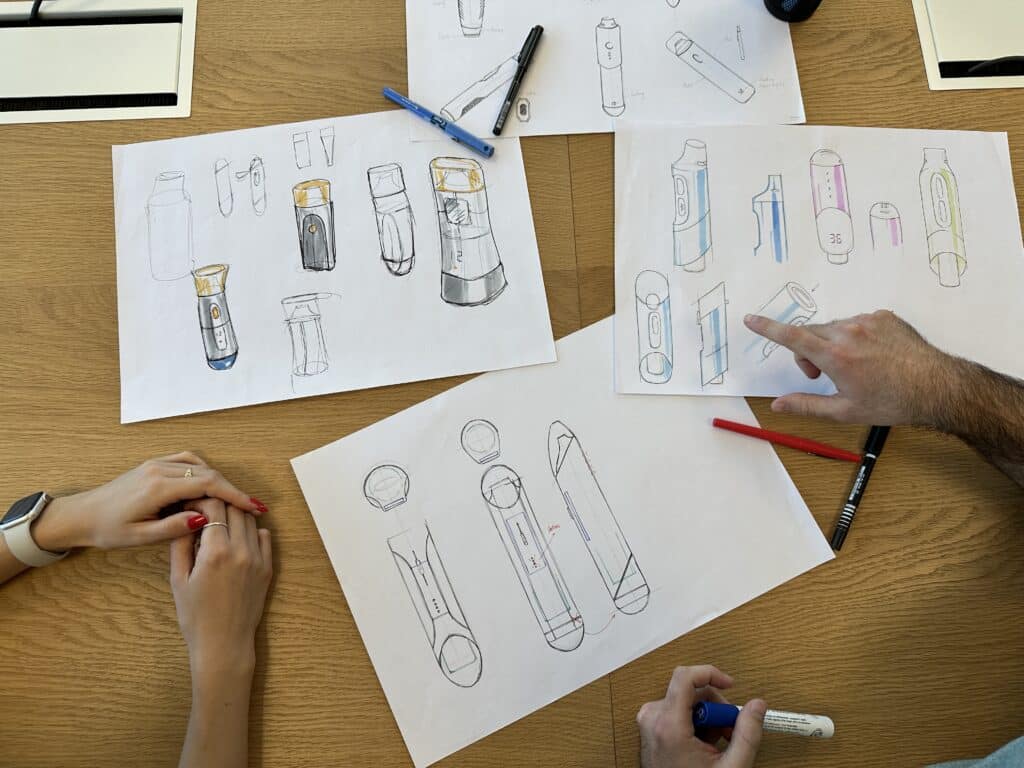
Concept generation explores alternative ways of meeting the design inputs, considering the technologies, materials, usability and, where relevant, software the device may need. The concepts are evaluated against the design inputs and the identified risks, and the most viable one is selected to move forward.
Alongside concept selection, early prototypes answer the specific questions and risks identified during innovation. Can this mechanism work? Is it safe? Does this form factor make clinical sense? Each build closes an unknown before it becomes a problem in a later stage.
Proof of concept
Concept design ends with a proof-of-concept prototype: a functional prototype that demonstrates the core principle works. It typically marks the point at which the project moves into detailed design. Alongside it, the stage defines a preliminary system architecture, completes a high-level risk assessment under ISO 14971 and opens the design and development file with its first entries.
The rigour of this stage carries forward, since requirements left vague or feasibility assumed instead of demonstrated tend to resurface downstream as rework, failed verifications, regulatory gaps and delayed milestones.
Detailed design and verification
Detailed design
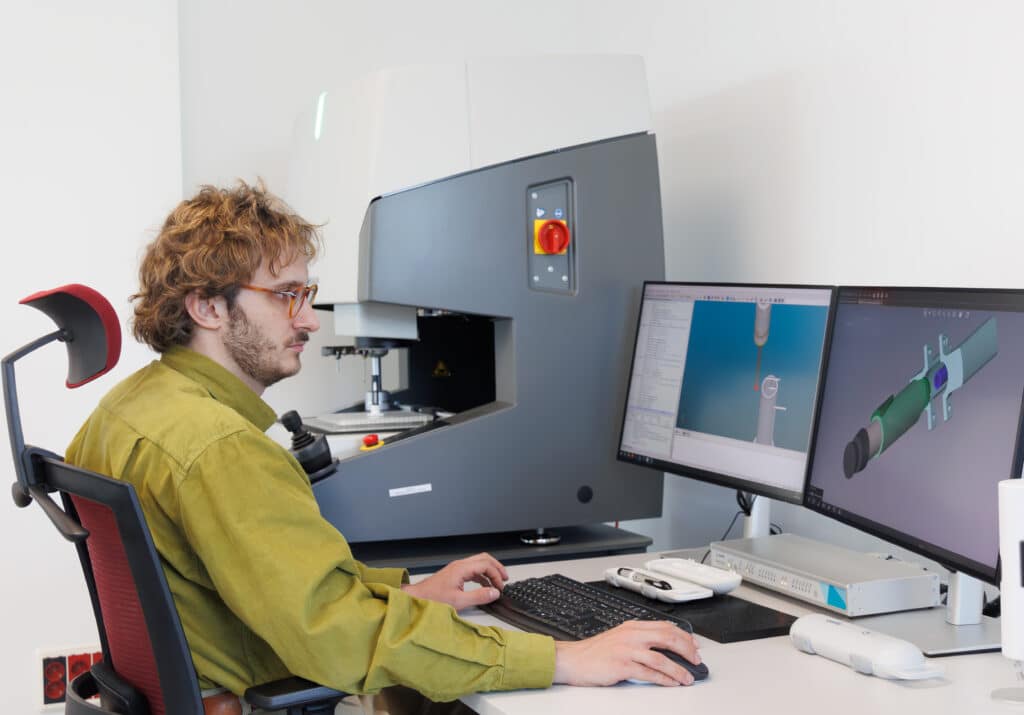
This stage resolves the concept into an advanced working prototype and refines it until the design is manufacturable and scalable. The work spans whichever disciplines the device requires, which can include mechanical design, materials selection, electronics and software. Mechanical design, for example, sets the tolerances, materials and processes for how the device will be manufactured and assembled. Where a device contains electronics, the design reaches high-quality, testable, EMC-compliant printed circuit boards (PCBs), and any software is developed under IEC 62304.
Design for manufacturing and assembly (DFM/DFA) runs alongside this work. A DFM/DFA review examines how the design will be produced and assembled, and removes cost and risk before the design reaches a manufacturer. These decisions are what make the design manufacturable and scalable: they determine whether the device can be built repeatably, to cost and to quality, once it moves to pilot manufacturing and production.
Risk management continues in parallel. Hazards, failure modes and use-related risks are analysed with methods such as hazard analysis and failure mode and effects analysis (FMEA). The resulting risk controls are built into the design and traced through the design outputs, meaning the specifications, drawings and bill of materials, and through the risk management file under ISO 14971.
Detailed design culminates in the design freeze. The outcome is a manufacturable, scalable design whose final manufacturing considerations are locked, so formal verification starts from a fixed baseline and the design is ready to transfer to pilot manufacturing.
Design verification
Design verification confirms that the device meets the design inputs it was built to. Each design output is tested against its input, using methods and quantitative acceptance criteria defined in a verification plan before testing begins.
The scope follows the device and typically covers:
- Functional and performance testing: bench testing checks each design output under relevant conditions of use.
- Mechanical verification: stress, fatigue and dimensional testing confirms the design meets its specifications.
- Software verification: where the device contains software, it is tested at unit, integration and system level in line with IEC 62304 and its software safety classification.
- Electrical safety and EMC: medical electrical equipment is tested against IEC 60601-1 and its collateral standards.
- Formative usability evaluation: studies under IEC 62366-1 identify use-related risks while the design can still address them.
- Risk control verification: each control in the risk management file is confirmed as implemented and effective.
- Biological evaluation: devices that come into contact with the body are evaluated under the ISO 10993 series.
- Sterilisation validation: devices supplied sterile have their sterilisation process validated.
Throughout verification, each activity is recorded in protocols and reports traceable to a design input or risk control, and that record becomes part of the technical documentation.

Pilot manufacturing and validation
Pilot manufacturing
This stage involves the device’s first controlled build, made with production-grade processes and materials or close equivalents. It tests the assembly workflow under real conditions, checks that production quality meets the requirements of ISO 13485, and yields the first units for design validation, clinical investigations or regulatory review, all before commercial tooling is committed.
The stage includes design transfer, the formal process of converting design outputs into the work instructions, bills of materials and quality procedures a manufacturer builds to. A process FMEA identifies where manufacturing variation could affect performance or safety before the first unit is built.
Decisions made here also carry forward: once the pilot build has settled the manufacturing technology, tolerances, materials and manufacturer, any later change to them goes through design change control and can require verification or validation to be repeated.
Design validation
Design validation confirms that the right device was built: that it meets user needs and its intended purpose in real or simulated clinical use. It covers three areas.
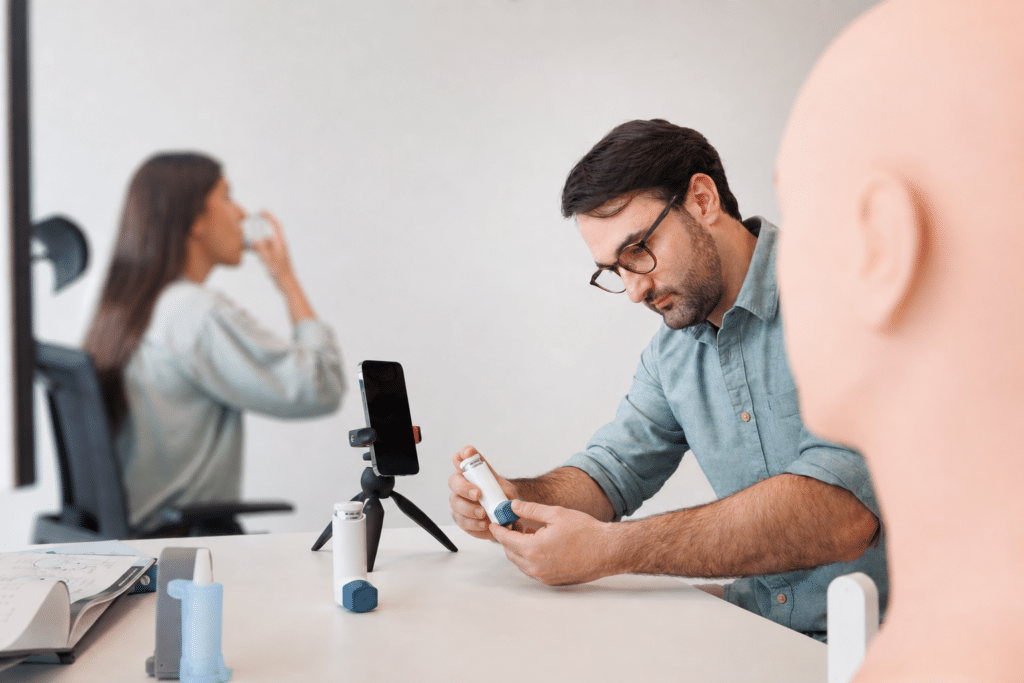
Usability validation: Human factors work runs across the whole of development. Formative evaluations start with early concepts and continue through to near-final devices, and each round feeds the use-related risk analysis (URRA). Validation then closes this work with the summative usability test, a confirmatory study on the finalised device whose pass and fail criteria are drawn from the URRA and which can be run by an independent usability test house. Behind this work, EU MDR requires manufacturers to reduce the risks of use error and IEC 62366-1 sets out the usability engineering process for doing so, while in the US the FDA’s human factors guidance sets out equivalent expectations.
Clinical evaluation: Clinical evaluation is a continuous process. It begins in the early planning phase with a clinical evaluation plan (CEP) which defines the intended clinical benefits, the relevant GSPRs, the state of the art and the benefit-risk acceptance criteria. As part of design and development validation, clinical data from clinical investigations, scientific literature and post-market surveillance, relating to the device or to a device for which equivalence has been demonstrated are appraised to confirm conformity with the relevant GSPRs and the acceptability of the benefit-risk ratio. The clinical evaluation report (CER) is approved before design validation is closed.
The CEP, the CER and the PMCF plan, or justification where PMCF is not applicable, form part of the technical documentation and are updated throughout the life cycle with PMS and PMCF data.
Risk file review: The risk management file is reviewed to confirm that the remaining risks are acceptable against the device’s clinical benefit before regulatory submission.
Regulatory submission
Regulatory submission is the stage where the evidence produced during development is compiled into technical documentation and submitted for assessment. Medical device technical documentation, formerly called the technical file, is the complete set of evidence that a device meets the applicable regulatory requirements. The route depends on the target market:
- European Union: technical documentation structured to EU MDR Annexes II and III. A notified body assesses it before CE marking for Class IIa, IIb and III devices, and for the sterility, measuring or reuse aspects of Class I devices that have them. Other Class I devices are self-declared by the manufacturer.
- United States: an FDA premarket submission, such as a 510(k), a De Novo request or a PMA, depending on the device’s classification.
- United Kingdom: technical documentation prepared to UK requirements for UKCA marking in Great Britain, assessed by a UK Approved Body where third-party assessment applies. CE-marked devices are also accepted in Great Britain under transitional arrangements, and Northern Ireland applies EU MDR.
Whatever the route, the documentation brings together:
- the device description, specification and labelling, including the instructions for use
- the design and manufacturing information
- the evidence of conformity with the general safety and performance requirements (GSPRs), including the verification and validation results, the usability engineering file and the clinical evaluation
- the risk management file under ISO 14971
- the post-market surveillance plan
Most of this content is produced in the earlier steps of the process, so the submission compiles records that already exist.
Industrialisation
Industrialisation, also called transfer to production, is the final step of the medical device development process. It translates the validated design into a consistent, controlled manufacturing process and scales production up to commercial volume. Production itself is carried out by a contract manufacturer (CMO), although the design team typically stays involved through the transition, since supplier qualification, the set-up of production and the optimisation of the design for manufacture at volume all depend on the design record.
The manufacturing technology is usually frozen during pilot manufacturing, so industrialisation scales up processes that have already been chosen. Which processes are used depends on the device and its production volume:
- CNC machining: delivers high dimensional accuracy, complex geometries, a wide range of materials, and cost-efficiency for low volumes.
- Injection moulding: offers high repeatability and consistency, which makes it a common choice for higher-volume parts.
- Additive manufacturing (3D printing): is better suited to low-volume or custom parts, though it is still treated with caution by regulatory authorities.
Before routine production starts, the manufacturing processes are validated, as ISO 13485 requires for any production process whose output cannot be fully verified by subsequent inspection or testing. This is commonly done through installation, operational and performance qualification (IQ, OQ and PQ). In parallel, suppliers of components and materials are qualified and controlled under the same quality management system.
Quality control then runs through the whole of production. Quality and compliance are assessed repeatedly until the end of the stage, so issues are addressed as soon as they arise. Throughout, regulatory responsibility stays with the legal manufacturer, who under EU MDR remains responsible for the device it places on the market even when production is outsourced. The stage is complete once the validated device is in full-scale manufacturing.
It’s not a linear process
The eight steps describe an order, but not a straight line. This is because later steps test the work of earlier ones, and when they expose a gap, work may go back to the step that produced it, sometimes more than once.
At Perdigó, we make this process as smooth as possible through our cohesive, multidisciplinary coverage of the full development cycle. Our mechanical, electronics, DfMA and regulatory experts work together from the outset, so the output stays consistent across all disciplines.
Develop your device with Perdigó Medical
You can engage Perdigó at any step of the medical device development process. Explore our services at every stage of the process or talk to an expert now.

FAQs
What is the intended purpose of a medical device, and why does it matter?
What are design controls?
Which standards guide medical device development?
Which regulations apply in the EU, the US and the UK?
Does every medical device need a clinical investigation?
Who is the legal manufacturer of a medical device?