
Share this article




Bringing a medical device to market requires demonstrating that it performs as intended not just when manufactured, but throughout its claimed shelf life. Accelerated aging is the method used to generate that evidence within a development timeline, producing data that supports an interim shelf-life claim while real-time aging studies run in parallel to confirmation.
At Perdigó Medical, we run accelerated aging studies, from protocol design through post-aging testing, interpretation, and documentation, for medical device companies at all stages of development.
What is accelerated aging?
Accelerated aging is a laboratory method that simulates the passage of time on a medical device or its packaging by exposing it to elevated temperature. The underlying principle is that the chemical and physical degradation processes that occur during real-time storage happen faster at higher temperatures, and that this relationship is predictable enough to allow controlled compression of time.
The scientific basis is the Arrhenius equation, which describes how reaction rates increase with temperature. For practical use in medical device shelf-life testing, this is simplified into the Q10 factor: the multiplier by which the rate of degradation increases for every 10°C rise in temperature.

ASTM F1980, the standard that governs accelerated aging for medical devices, sets a default Q10 value of 2, meaning that for every 10°C increase above the ambient reference temperature, degradation is assumed to proceed twice as fast. This default is a practical convention, not a physical constant. The actual Q10 for a given material can differ, and for studies where the default is not appropriate, a material-specific value can be used with supporting justification.
The aging temperature you select determines how much real time is compressed. At a Q10 of 2, a device aged at 55°C against a 25°C reference accumulates roughly eight times the equivalent real-time aging per day compared to storage at ambient conditions.
A higher aging temperature shortens the study duration further, but this is bounded by material limits: the temperature must not be high enough to introduce degradation modes that would not occur under normal storage conditions. Selecting the right aging temperature requires knowing what the device and its packaging are made of, and what those materials can tolerate.
For medical device development, an accelerated aging study is what makes it feasible to pursue regulatory submission on a realistic timeline. A 24-month shelf-life claim backed only by real-time data would require 24 months before any submission could be made. Accelerated aging compresses that window while real-time aging runs concurrently, ultimately serving as confirmatory data.

The accelerated aging protocol
Before a single sample goes into a chamber, the study needs a protocol. The protocol is the document that defines all study parameters and the rationale behind each of them. A well-constructed protocol is also what gives the resulting data regulatory defensibility.
Under ASTM F1980, the protocol specifies:
- Q10 and aging temperature: The Q10 value used, whether the default of 2 or a material-specific figure, must be declared. The aging temperature must be justified against the thermal limits of all materials in the device and packaging configuration being tested. If the selected temperature could mask or introduce degradation that would not occur at ambient storage conditions, it is not appropriate.
- Calculated aging duration: The accelerated aging time is derived from the target shelf life, the reference temperature, the aging temperature, and the Q10. The formula is defined in ASTM F1980. The calculated duration is the minimum time samples must spend in the chamber to generate data equivalent to the target shelf life.
- Time points: Some studies test at interim time points rather than only at the end of the aging period. This is relevant when the shelf-life claim spans multiple intervals, or when the client needs data supporting a shorter interim claim while working toward a longer one.
- Sample size and allocation: The number of samples must be sufficient to support the statistical validity of the post-aging testing. Sample allocation accounts for any interim pulls, the final time point, and any reserve samples.
- Humidity: Humidity is a controlled parameter in the chamber. Where packaging or materials are sensitive to moisture, humidity is set as part of the study conditions rather than left uncontrolled.
“Working with Perdigó on the mechanical characterization of our device has been key to advancing in the development of our product. The Perdigó team understood from the beginning that GlioHook is not a standard device. They designed tailor-made test protocols, maintained fluid communication at all times and delivered the complete and traceable reports on time. It was an agile and technically very solid collaboration.”
– Sara Muñoz, RAQA at Batea Oncology
Testing the aged samples
Aging and post-aging testing are distinct steps in the process, each with its own protocol and report. The aging step generates samples that have been subjected to the equivalent of the target shelf life under defined conditions. Testing then determines whether those samples still meet the device’s performance and material requirements.
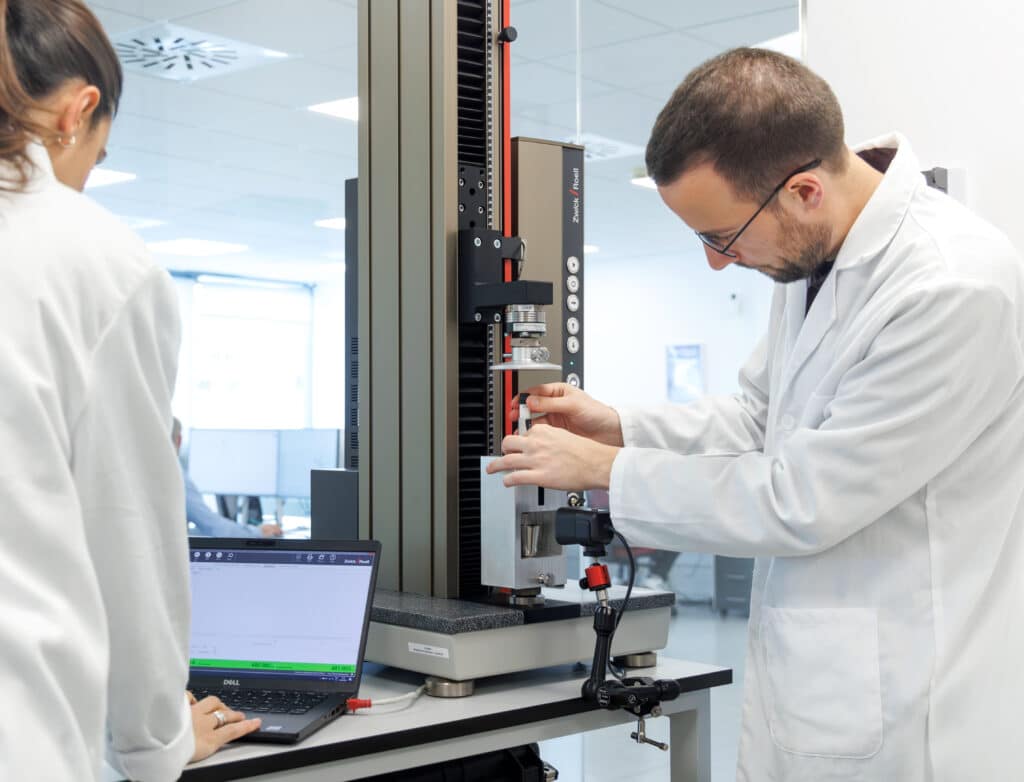
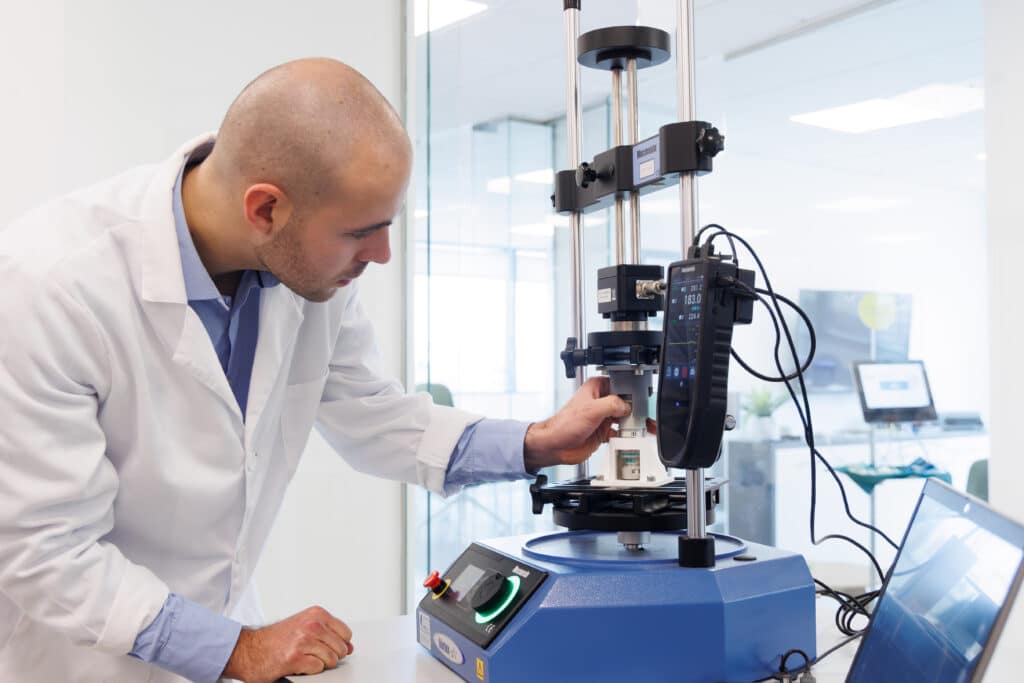
What that testing covers depends on the device. For a sterile device in primary packaging, sterile barrier integrity testing is required. Mechanical testing is relevant to devices or components where dimensional stability, tensile strength, peel force, or other physical properties determine whether the device functions as intended. Electrical testing applies where the device incorporates electronics, connectors, or any component with specified electrical performance.
Perdigó Medical performs mechanical and electrical testing in house. This means samples don’t need to be transferred to a separate laboratory between aging and testing, which reduces handling risk and turnaround time.
The tests are run against defined acceptance criteria: the thresholds that the manufacturer has established as the minimum acceptable performance for the device.
Where a client comes to us without acceptance criteria already defined, we can run characterisation studies.
A characterisation study measures the performance and variability of un-aged samples to establish a baseline from which acceptance criteria can be derived with statistical justification. Those criteria still need to be tied back to the device’s intended use, design inputs, and risk management file before they can serve as the thresholds against which aged samples are assessed.
The range of devices we work with spans very different clinical contexts. In one case, an astrocytoma implant intended for direct contact with brain tissue, where aging data is used to confirm that material stability and biocompatibility hold over shelf life before the device is implanted, and where the margin for performance variation is narrow. In another, an embryo transfer catheter used in IVF procedures, where mechanical properties such as flexibility, tip behaviour, and dimensional tolerance are the primary concerns.
The testing protocols and acceptance criteria differ substantially between those two cases, and the protocol design reflects the device’s specific clinical use and risk profile.
Investigating inconclusive and failing results
Mechanical and electrical performance testing does not always return a clean result. Units within a sample set can behave differently from one another, readings can fall close to the acceptance threshold, or a sample can fail outright. When that happens, the first question to ask is why?
This is the point at which Perdigó does more than reporting. We investigate the results by examining the samples, device design, and intended performance. Where necessary, we also design and run further targeted tests to understand where the issue lies and why it arose.
Our accelerated aging services
Our accelerated aging service covers the full sequence from study design to documented output:
- Protocol design: We write the protocols that govern the study — both the aging protocol under ASTM F1980 and the post-aging testing protocols — as distinct documents. For aging, we select and justify the aging temperature, Q10, duration, time points where applicable, sample allocation, and humidity conditions. For testing, we define the methods and acceptance criteria for each modality the device calls for.
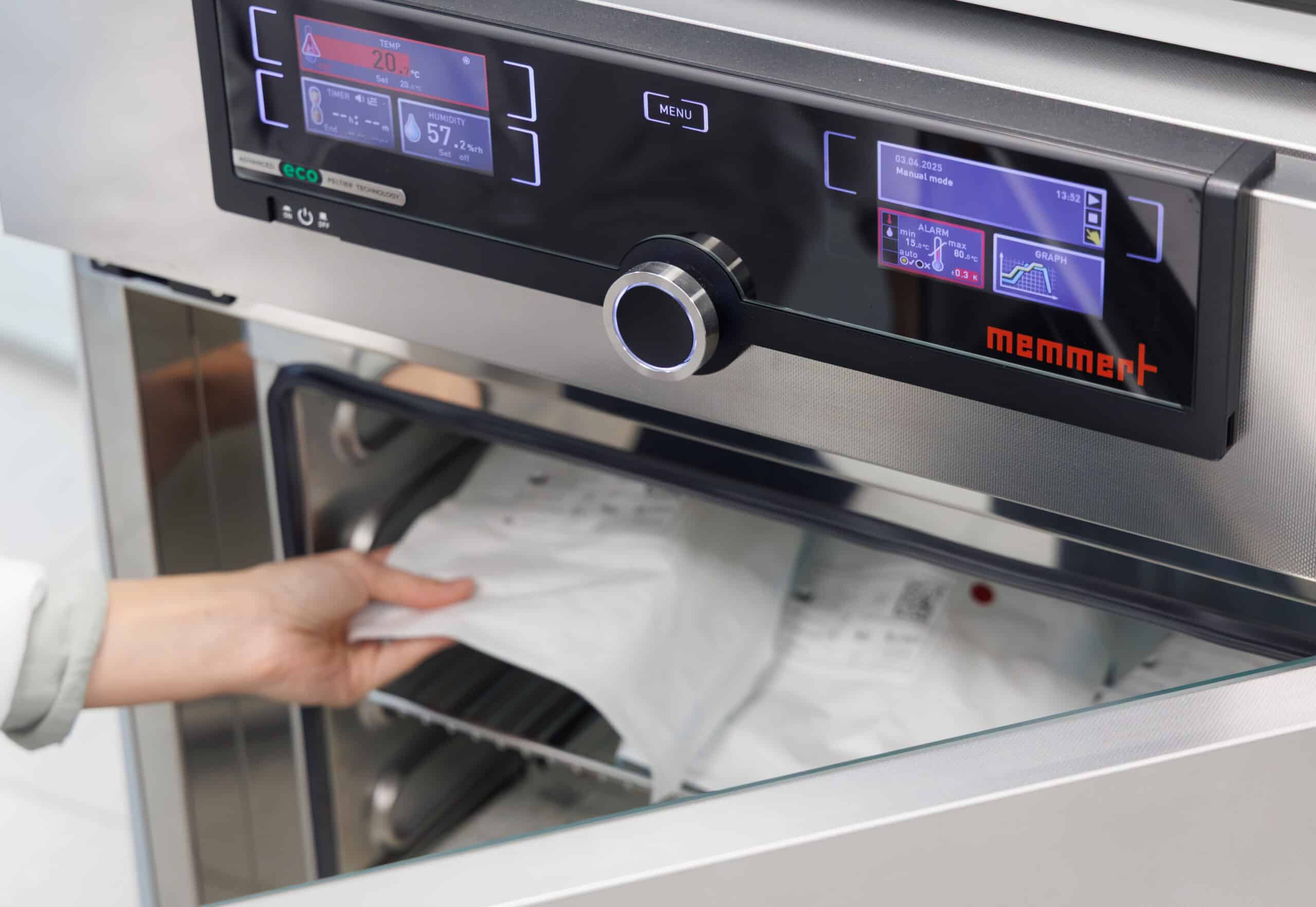
- Aging: Samples are conditioned in our chamber under the protocol conditions for the calculated duration.
- Post-aging testing: Aged samples are tested against defined acceptance criteria. Mechanical and electrical testing are performed in house. Other modalities are coordinated with qualified external partners where required.
- Characterisation studies: Where acceptance criteria have not yet been defined, we run characterisation studies to establish baseline performance and derive criteria that are statistically justified and traceable to intended use, design inputs, and the risk management file.
- Investigation and Interpretation: Where results scatter or fall near a threshold, we investigate the test method, the samples, and the sample size to establish what the data actually shows, and we build the documentation needed to substantiate the study outcomes in a regulatory submission.
- Reports: Each study is documented in its own report covering the protocol, the conditions applied, the results, and the conclusions.